A vehicle moves through your wash tunnel. Another follows behind it. Knowing where they are, how their spacing changes and whether they keep moving can help an operator understand what is happening while there is still time to respond. That is the idea behind Tunnel Eye AI, a camera-based system we are developing at Total Web Solutions.
See the vehicles moving through your tunnel
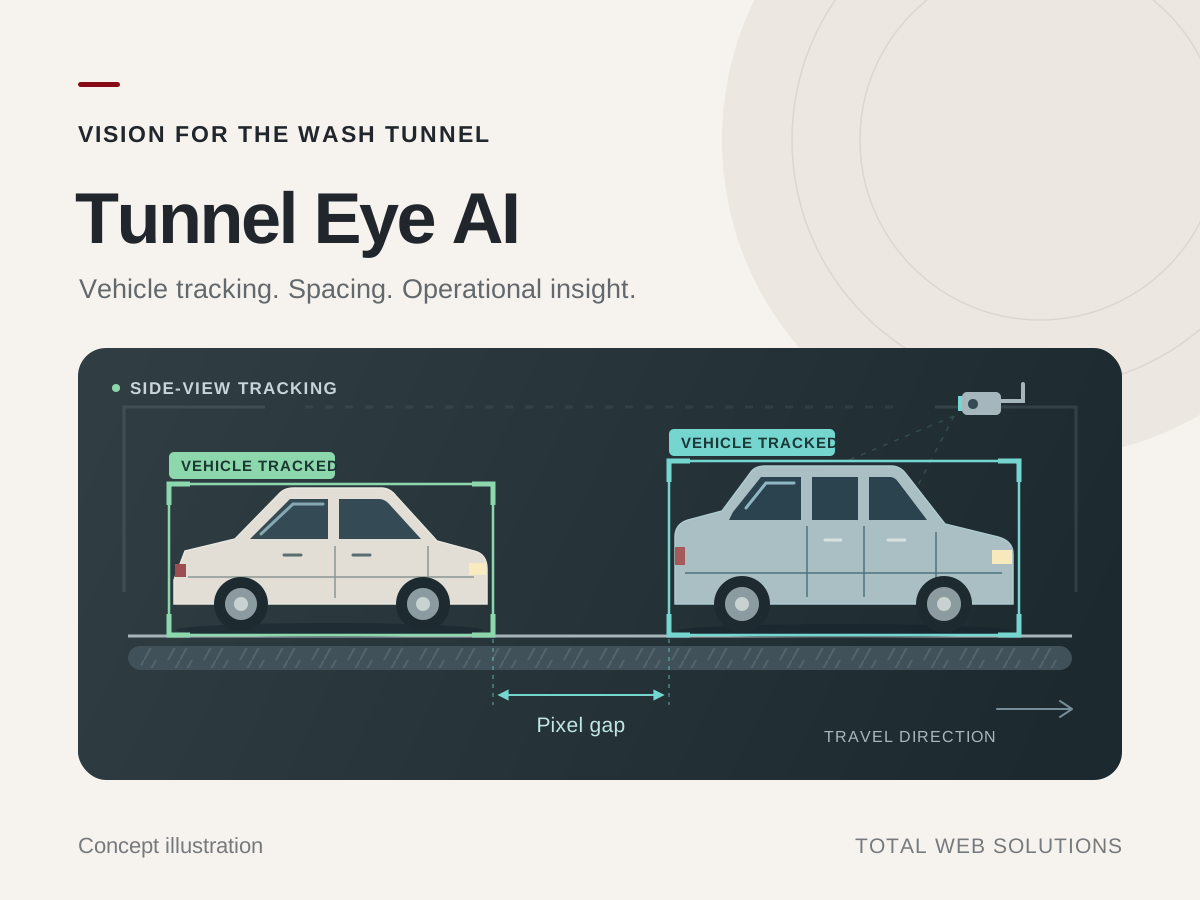
One of the most encouraging things to watch during testing is the detection box itself. In our side-view work, the box follows the visible outline of the vehicle closely as it moves across the camera view. You can watch the software identify the car and update its position from frame to frame.
Camera placement makes a difference. A view facing an approaching vehicle may offer limited separation between cars. A suitable side view can make the vehicle boundaries and the space between neighbouring cars much easier to observe. Choosing that view is part of designing the installation around the tunnel.
Those observations give us a foundation to build on. The next questions are practical: is the vehicle progressing through the expected area, is another getting closer, and has something changed that deserves attention?
Measure the visible gap between vehicles
When two vehicles are visible together, their detection boxes let the software calculate the pixel gap between them. In our current testing, that produces a clear, useful measurement of their separation in the image. Watching the boxes and the gap update together makes the potential easy to see.
Pixels describe the camera image. Camera angle, perspective and vehicle shape affect how that gap relates to the actual clearance between bumpers. Turning it into a physical distance needs calibration; even a pixel-based warning threshold needs to be checked at the installed view.
Our gap monitor currently displays warnings for development and review. Extending those warnings into automatic conveyor responses means accounting for processing delay, conveyor speed and the time the equipment takes to stop. The goal is to recognize a developing spacing problem early enough for a useful response, with the complete response tested at the wash.
Notice when a vehicle stops progressing
Spacing is only part of the picture. On a chain-and-dolly conveyor, a roller pushes a tire to move the vehicle through the wash. If the conveyor continues moving while the vehicle stops advancing, that mismatch is something an operator would want to know about immediately.
A vehicle may have passed over a roller, the driver may be braking, or another problem may be preventing normal progress. The camera would be detecting unexpected movement rather than diagnosing the mechanical cause. That distinction still leaves a valuable opportunity: flag the situation and, with an appropriate controller connection, request a conveyor pause.
This is a direction we are exploring for Tunnel Eye AI. It calls for reliable information about actual conveyor operation, tracking over time and rules suited to the conveyor type. Belt and chain systems need their own assessment of what normal movement looks like and when a response should occur.
Turn vehicle activity into useful reports
The same tracking work opens another avenue: understanding the flow of business through the tunnel. A count of cars visible right now is a starting point. A completed-vehicle count needs to follow each vehicle through a defined passage so the same car is counted once, rather than repeatedly as it appears in successive frames.
From there, future reports could help answer questions operators ask every day:
- Vehicle volume: how many vehicles passed through during the hour or day?
- Throughput: when did vehicles move steadily, and when did progress slow?
- Loading patterns: how did the observed spacing change through a busy period?
- Interruptions: when did a stop occur, and what did the camera show at that time?
Imagine reviewing a busy afternoon and being able to connect a slowdown with the relevant video. That could help you investigate an exit delay, adjust a loading procedure or discuss a recurring issue with your team. Live operational reports and historical summaries are development goals; useful reporting will depend on validating the underlying counts and event records.
Build the view around the wash
Every tunnel has its own sightlines. Equipment, brushes, spray and changing light can interrupt a view that looks clear when the wash is empty. The planning starts with the areas you need to understand: loading, movement through the tunnel, the conveyor end or the exit beyond it.
Multiple cameras could extend that coverage. Each needs a useful angle and testing through normal wash conditions. Where views overlap, tracking must account for the same vehicle appearing in more than one camera, especially before combining counts into a tunnel-wide report.
A modular approach is part of the opportunity. Start with a defined problem and assess the cameras, computing equipment and controller connections it needs. Broader coverage can then be considered against the value it adds. Existing equipment compatibility and installation requirements need to be confirmed for each location.
Start with a question you want answered
You might want a clearer view of vehicles at the conveyor exit. You might want to understand an unexplained stop, monitor spacing or eventually compare vehicle volume across the day. A specific question gives the camera placement, tracking rules and operator display a purpose.
Tunnel Eye AI continues the practical camera work behind Bay Eye AI car wash monitoring, with a focus on tunnel movement and the information it could provide. We are encouraged by what we are seeing in development, and we are building toward tools that help operators recognize problems and understand their wash more clearly. Conveyor responses must be validated alongside the wash's existing controls and protection systems.
What would you like to see more clearly in your tunnel? Tell us about your conveyor, the area you want to monitor and the question you want answered. We can discuss the current development work and what an evaluation at your wash would involve.